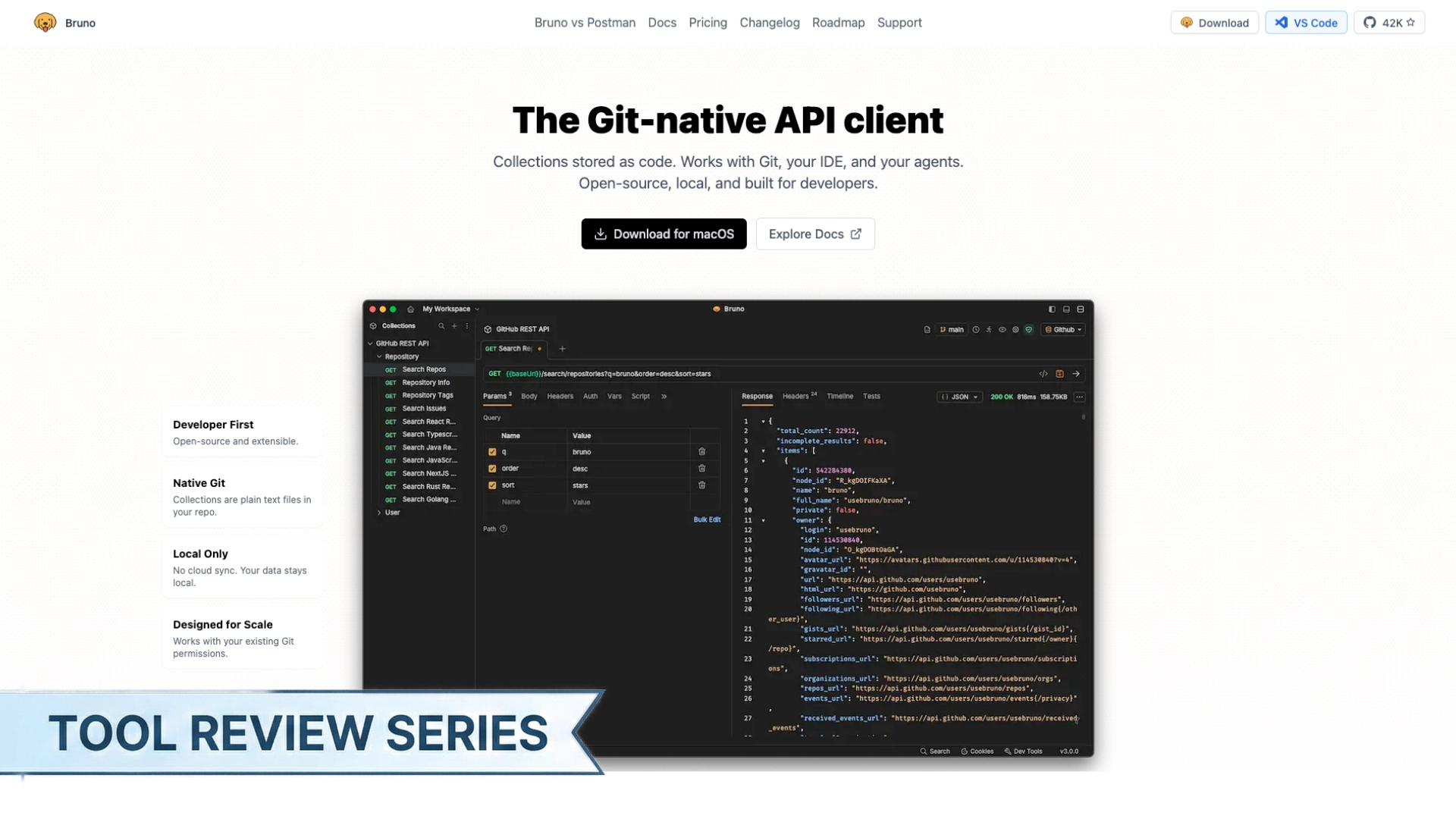
Tool: Bruno
Category: API Client / Developer Tool
Pricing: Free (open source) / Pro $6/mo / Ultimate $11/mo
An open-source, git-native API client that stores your API collections as plain files on your filesystem. Think git, not cloud.
What It Does
Postman killed free team collaboration on March 1, 2026. If you were on a free team plan, you woke up to a paywall. That’s sent a lot of developers looking for alternatives, and Bruno is the one that keeps coming up.
Bruno takes a different approach to API testing. Your collections live as plain .bru files in your project repo, right next to the code they test. No cloud account, no proprietary format. You version-control your API collections the same way you version-control everything else: git.
The numbers back up why people are paying attention. 41.7k GitHub stars, over 600k monthly active users, and the app runs at around 80MB of RAM. Postman regularly sits at 300-600MB. Bruno starts in under a second. Postman takes long enough that you start wondering if it crashed.
V3 dropped in January 2026 and it was a big one. New UI, workspace support, YAML alongside their .bru format, an in-app terminal, and a reworked Git UI that makes committing collection changes less painful. It feels like the release where Bruno went from “promising alternative” to “actual product.”
Update (March 2026): Postman shipped a big update of their own this month. Native git integration, a new Collection v3 format that breaks collections into diffable YAML files, MCP support for AI tooling, and another UI refresh. Credit where it’s due, they’ve closed the git gap on paper.
But here’s my honest take: it still feels like the same Postman underneath. The UI gets refreshed but the experience is still heavy, still slow to start, still eating 300-600MB of RAM. You still need to log in constantly because the session life is short. And features that used to be free keep moving behind paywalls. It reminds me of a tool stuck in 2017 trying to look modern by bolting on AI and UI updates. Bruno’s simpler interface is the opposite of that. I’d rather have fewer features that work well than a dashboard packed with things I’ll never touch. That’s a personal preference, but it’s a strong one.
In practice
I imported one of my Postman collections, about 30 requests across a few folders. Came through fine, but the folder ordering got rearranged. Spent a few minutes dragging things back into place.
Using it day-to-day, you feel the speed difference. Responses come back fast, switching between requests has zero lag. I stopped thinking about performance because there was nothing to wait for. Sounds like a small thing, but going back to Postman after this is jarring.
The git workflow is what sold me. You change a collection, commit from Bruno’s Git UI, push. Your teammate pulls and they’ve got the same thing. No more “did you export the latest version?” on Slack. The collections are just files, git handles the rest.
Additionally, CLI AI tools like Codex and Claude Code work really well with this. Because Bruno collections are just files in your repo, these tools can read your API structure, understand it, and generate new .bru requests straight from the terminal. You skip the UI entirely. Need a test for a new endpoint? Ask your AI tool to write it. It already knows your collection layout, your environment variables, the patterns you’ve been using.
Postman now has MCP support for AI integration, but it’s a different experience. You need to set it up, log in, configure the connection, and maintain it. With Bruno I just point a CLI agent at the files and it works. Zero setup, zero authentication, zero friction.
Pricing Comparison
| Bruno Free | Bruno Pro | Postman Free | Postman Team | |
|---|---|---|---|---|
| Cost | $0 | $6/mo | $0 | $19/user/mo |
| Team collaboration | Via git | Via git + extras | Gone (as of March 2026) | Included |
| Cloud sync | No (local/git) | No (local/git) | Yes | Yes |
| Open source | Yes (MIT) | Core is MIT | No | No |
| Collection storage | Filesystem (.bru) | Filesystem (.bru) | Filesystem (v3) + cloud | Filesystem (v3) + cloud |
Feature Comparison
| Feature | Bruno | Postman | Insomnia |
|---|---|---|---|
| Collection storage | Filesystem (.bru files) | Cloud + local filesystem (v3) | Local + cloud sync |
| Git integration | Native (collections are files) | Native git (March 2026) | Git sync available |
| AI/CLI integration | Files readable by any CLI tool | MCP (requires setup + login) | Limited |
| RAM usage | ~80MB | 300-600MB | ~150-250MB |
| Startup time | Sub-second | Several seconds | A few seconds |
| Auth methods | Basic, Bearer, OAuth2, API Key, AWS Sig v4 | 12+ auth types | Basic, Bearer, OAuth2, and more |
| Protocols | HTTP, GraphQL, WebSocket | HTTP, GraphQL, WebSocket, gRPC, MQTT | HTTP, GraphQL, gRPC, WebSocket |
| Monitors / scheduled runs | No | Yes (paid) | No |
| Test history | No | Yes (cloud) | Limited |
| Postman import | Yes | N/A | Yes |
| Collaboration model | Git-based | Cloud workspaces + git | Cloud or git |
| Pricing floor for teams | Free | $19/user/mo | Free (limited) |
Pros
- Free and open source — MIT licensed, 41.7k stars on GitHub. If a vendor pulls a Postman and changes pricing, you fork and move on
- Git-native — collections are plain text files in your repo. Diffs are readable, merges work, and your API tests sit next to the code they test
- Fast and lightweight — ~80MB RAM, sub-second startup. Postman feels sluggish in comparison
- V3 is a real upgrade — new UI, workspaces, YAML support, in-app terminal, better Git UI. It closed a lot of the “it looks rough” gap
- Nothing leaves your machine — no telemetry, no cloud account. Your requests stay between you and the API you’re hitting
- Postman import works — you can bring your existing collections over without rebuilding from scratch
Cons
- Fewer auth methods — if you need Digest, NTLM, Hawk, or some of the more niche auth types Postman supports, Bruno doesn’t have them yet
- No monitors or test history — there’s no built-in way to schedule runs or track test results over time. You’d need external CI for that
- Git-only collaboration can be a wall — if your team includes PMs or QA people who don’t use git, they can’t easily access or edit collections. Postman’s cloud workspace model is simpler for mixed teams
- Golden Edition was discontinued — Bruno used to sell a one-time-purchase “Golden Edition” and dropped it, which frustrated some early supporters. The subscription model is cheap, but the precedent is worth noting
- Import can reorder folders — when importing from Postman, folder ordering sometimes doesn’t match the original. Minor, but annoying if you have a carefully organized collection
Verdict
Postman has narrowed the gap with native git and MCP support, but the differentiators still hold. Bruno is the pick if you want something open source, fast, lightweight, and simple. No login, no vendor lock-in, and CLI AI tools just work with it out of the box.
It’s NOT the pick if your team includes non-developers who need access to API collections, or if you rely on advanced auth methods, scheduled monitors, or cloud-based test history. Postman still does those things better.
Rating
Overall: 5/5