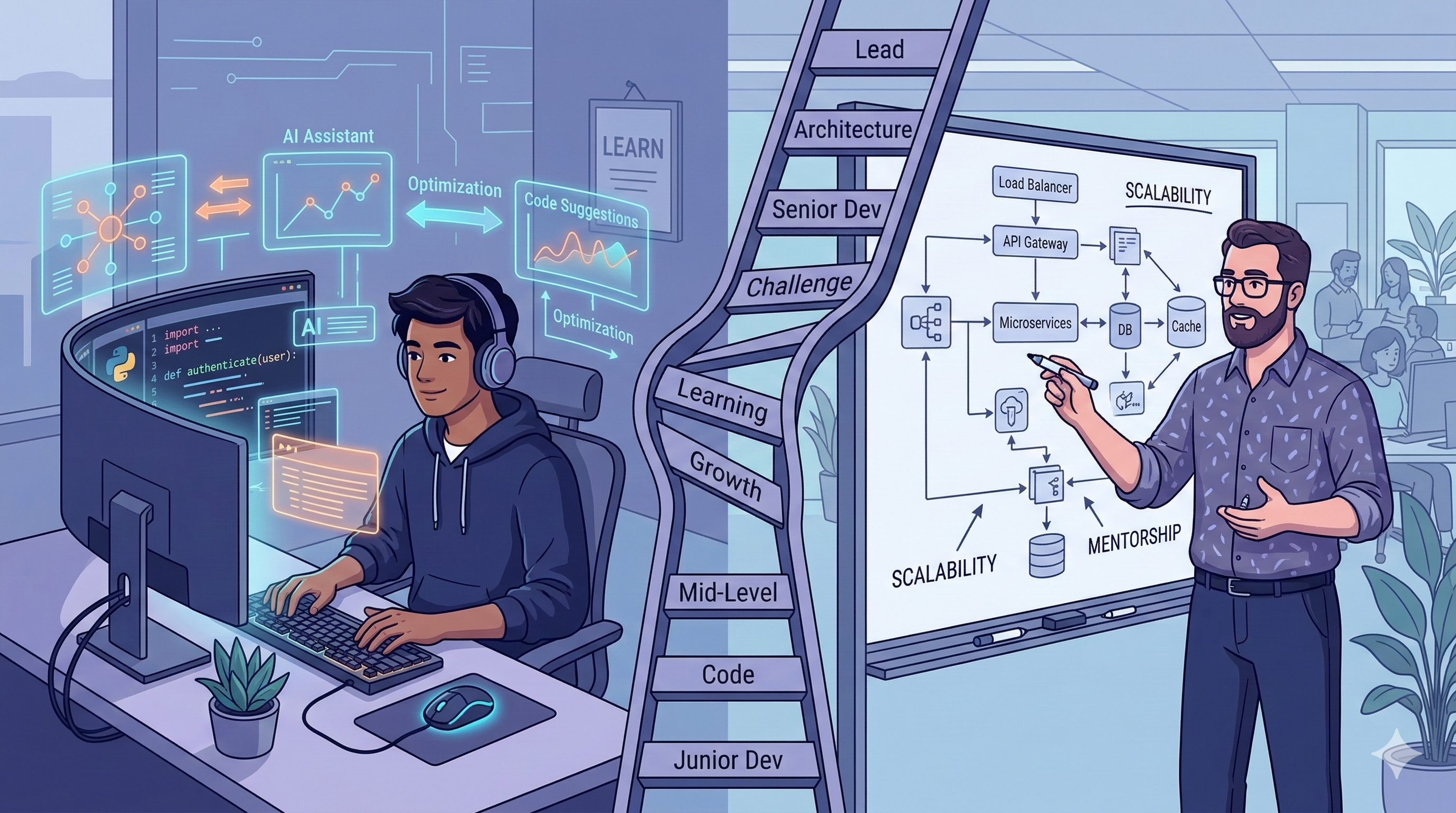
There’s a question I keep hearing in dev circles lately: “Why would I hire a junior when AI can do their job?” That’s the wrong question. The right one is: why would I hire an expensive senior when a junior with AI tools can match their implementation output?
The answer, as usual, is more complicated than either side wants to admit. Most companies haven’t figured out the junior + AI combo yet — they’re still defaulting to “hire senior or use AI instead.” But I think that’s about to change, and the companies that get there first will have a serious edge.
Juniors just got a massive upgrade
A junior developer today isn’t the same junior from three years ago. Give them Claude, Cursor, or Copilot and suddenly they’re solving problems they wouldn’t have even understood before, because AI walks them through the reasoning. Tasks that used to take a mid-level dev days are getting shipped in hours.
I’ve seen this firsthand at Meridian - a designer on our team built an entire client dashboard prototype in two days using Cursor. A year ago, that same task would’ve been scoped for a mid-level dev across a full week. The code needed review, sure, but the output was there.
The data backs this up:
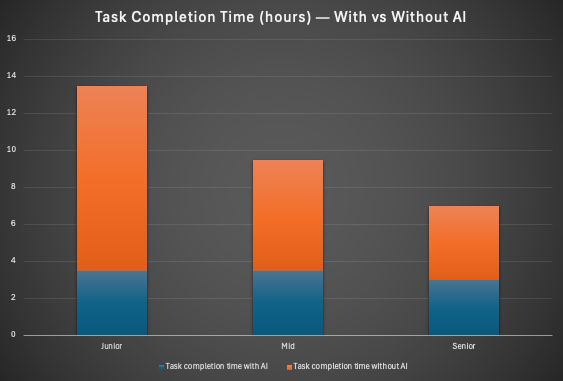
- 55% faster task completion with Copilot (GitHub’s own study)
- PR cycle times dropped from 9.6 days to 2.4 days — juniors see the largest speed gains
- For simpler tasks like restructuring code or writing tests, speedups hit up to 90%
- AI tools now write 41–46% of all code, and 88% of AI-generated code stays in the final version
- 84% of developers already use AI tools (Stack Overflow’s 2025 survey)
And the best part for the employers: they’re cheaper. Way cheaper.
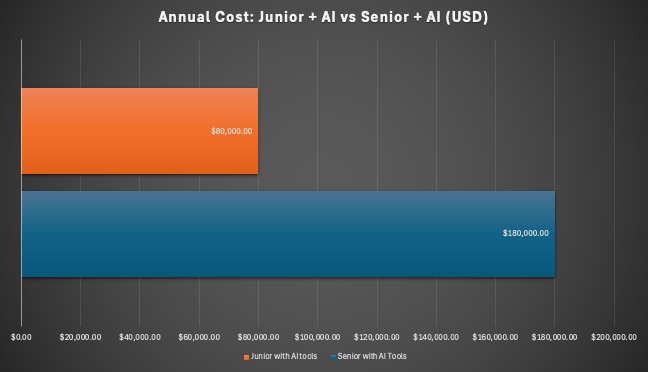
- Junior developer: $73K–$87K/year (US average)
- Senior in a major hub: $165K–$220K/year — that’s 2–3x the cost
- AI subscription: $20/month ($240/year)
Throw it all together and the junior’s total cost is still well under half of a senior’s salary.
They’re more adaptable than you think
Juniors don’t push “this is how we’ve always done it.” They adopt new tools, new frameworks, new internal processes without resistance. Need them to switch from REST to GraphQL? They’ll prompt their way through it by Tuesday. They won’t define the best system design or caching strategy on their own, but they’ll get a working implementation up fast enough to iterate on.
Seniors, on the other hand, often have strong opinions about how things should be built. That is really valuable of course, but only if they are open-minded. When the digital land shifts as fast as it does right now, being adaptable matters more than being opinionated.
There’s also a motivation difference. Juniors know they need to prove themselves every single day. That anxiety of needing to constantly learn and deliver never really leaves them. AI is a perfect tool for channeling that drive — juniors who lean into these tools are leveling up at a pace we haven’t seen before.
The senior role is changing whether you like it or not
So if juniors can now handle more implementation work with AI assistance, what does that mean for seniors? The answer is: everything that isn’t writing code.
Seniors are going to spend more time reviewing code than writing it. When you have three juniors shipping at 2x speed with AI, someone needs to make sure that code actually makes sense, follows good patterns, and doesn’t introduce technical debt.
But beyond code reviews, seniors will need to invest more time in mentoring — because juniors are going to advance faster now. They’re absorbing knowledge at an accelerated rate with AI. That means they’ll hit the “I know enough to be dangerous” phase quicker, and they’ll need experienced developers to guide them through the nuances that AI can’t teach:
- How to design robust systems
- Trade-off decisions and knowing when “good enough” is good enough
- How to prioritize when everything feels urgent
- How to spot edge cases before they become production incidents
The career ladder is getting weird
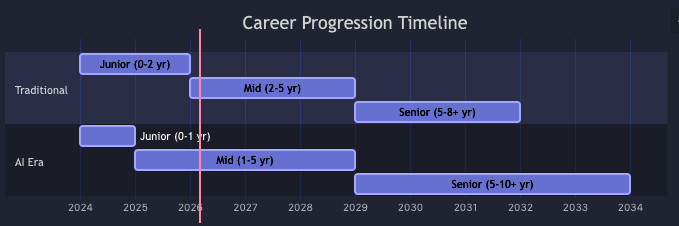
Think about how we define junior, mid, and senior today. It’s mostly based on years of experience and the complexity of work you can handle independently. AI is about to change those metrics.
The junior-to-mid transition is going to accelerate. If you can ship mid-level features with AI assistance in your first year, you’re going to hit that mid-level ceiling much sooner. That’s great for juniors — faster career growth, faster salary bumps.
But the switch from mid to senior? That’s going to become even harder. Seniority isn’t and shouldn’t be about writing code faster or working for more years. It’s about system design, architectural decisions, understanding business context, and leading teams. AI doesn’t help much with any of that. You still need years of seeing systems fail, making bad decisions, and learning from production incidents to develop that “feeling.”
An Anthropic study found that AI assistance led to 17% lower mastery scores on coding assessments. Juniors are getting promoted faster, but they might be arriving with skill gaps they don’t even know about.
So we might end up with a lot of mids who got there quickly, but remain as mids for a long time. That changes how companies should think about hiring, compensation bands, and growth paths entirely.
So what actually happens?
I don’t think juniors go extinct. I think they become the best value hire in tech. Companies that figure this out early are going to move faster than teams that haven’t adapted their roster yet.
And seniors aren’t going to have less work. They’re going to have different work. Less time in VS Code, more time in pull requests, architecture docs, and meetings with their team. If that shift doesn’t excite you, it’s worth asking what part of the job you actually love.
The developers who thrive — junior or senior — will be the ones who stop asking “will AI replace me?” and start asking “how do I become more valuable because of AI?”
- For juniors: use AI as a learning accelerator, not a do-it-all
- For seniors: double down on system thinking, mentorship, and the judgment calls that no model can make for you
The game for developers isn’t over. The rules just changed.
Sources
- Stack Overflow Blog — AI vs Gen Z — entry-level hiring decline, employer sentiment
- Nucamp — Junior Developer Hiring Crisis — new grad hiring statistics
- GitHub Copilot Statistics (Panto) — 55% faster task completion, PR cycle time reduction
- Index.dev — Developer Productivity Statistics — AI code generation rates, code retention stats
- Stack Overflow 2025 Developer Survey — 84% AI tool adoption
- ZipRecruiter — Junior Developer Salary — junior salary ranges
- FullScale — Senior Developer Salary — senior salary data
- Terminal.io — Senior vs Junior Salary Guide — salary comparison
- Hakia — Junior to Senior Career Path — traditional career timelines
- Anthropic Research — AI Assistance & Coding Skills — 17% lower mastery scores
- METR — AI & Experienced Dev Study — 19% slower on complex tasks
- Faros AI — AI Software Engineering — org-level performance gains data